On 25 July 1239, a small group of Cistercian monks crossed Southampton Water from Beaulieu Abbey and set foot on the wooded slopes above the shoreline. They had come to found a new monastery on land purchased by a man who would never see it built. Nearly 800 years later, the walls they raised still stand – the most complete Cistercian abbey ruins in southern England.
This is the story of Netley Abbey: monastery, mansion, and ruin.
A Bishop’s Memorial (1236-1239)
Netley Abbey exists because of one man’s desire to be remembered.
Peter des Roches was no ordinary churchman. A Frenchman from the Touraine region, he rose to become one of the most powerful figures in medieval England. As Bishop of Winchester from 1205 until his death in 1238, he crowned the young Henry III, served as his tutor, and wielded enormous political influence. He fought at the Battle of Lincoln in 1217 and accompanied Emperor Frederick II on the Sixth Crusade, personally financing the fortification of Jaffa and Caesarea. On Palm Sunday 1229, he entered Jerusalem with the Emperor – one of the few Englishmen to walk those streets during the brief Christian reoccupation.
But des Roches was also a man of contradictions. The chroniclers called him the “Butterfly Bishop” after a peculiar legend that he could produce butterflies from his closed hand – supposedly a gift from King Arthur himself, encountered while hunting. His final recorded public statement, in 1238, came when Saracen ambassadors arrived seeking Christian help against the Mongol advance. Des Roches reportedly told them to “let the dogs devour one another.”
In his final years, the bishop turned his mind to eternity. He planned two monasteries as memorials to himself: La Clarté-Dieu in his native France, and a new Cistercian house on the Hampshire coast. He began purchasing land around 1236, but death came before the work was complete. His executors finished what he had started.
The site they chose sat in a slight hollow above Southampton Water, sheltered by wooded slopes. It met the Cistercian requirement of remoteness from towns while remaining accessible by sea – a detail that would shape the abbey’s entire history.
Royal Patronage and Construction (1239-1290)
The first monks arrived from Beaulieu Abbey, Netley’s mother house across the water. They dedicated their new home to the Blessed Virgin Mary and to Edward the Confessor, giving it the official title Ecclesia Sanctae Mariae de loco Sancti Edwardi – the Church of St Mary at Edward’s Place. The name “Netley” likely evolved from “Letley,” an early variant recorded in documents.
Those first years were difficult. Des Roches had died before securing adequate endowments, and the young community struggled financially. They probably lived in temporary wooden buildings while contemplating the stone monastery they could not yet afford to build.
Everything changed when the abbey caught the attention of King Henry III.
Henry was a passionate builder and patron of religious houses. His great project was the rebuilding of Westminster Abbey, and he took a personal interest in Netley from the mid-1240s. By 1251, he considered himself the abbey’s true founder and patron – a claim he made literal by having his name inscribed on the great piers of the church crossing. Three of those inscriptions survive today: “H DI GRA REX ANGL” – Henry, by the Grace of God, King of England.
Royal money transformed the project. The church that rose on the Hampshire shore was 72 metres long, built in the fashionable French-influenced Gothic style that Henry’s masons were perfecting at Westminster. Grants of lead and oak in 1251 and 1252 suggest the church was being roofed around that time. A silver-gilt processional cross arrived in 1253. Construction proceeded from east to west, with the sanctuary and transepts completed first so that services could begin while work continued on the nave.
The interior was richly decorated – surprisingly so for an order that officially prized austerity. The walls were plastered and painted in white and maroon with geometric patterns designed to mimic ashlar masonry. The floors gleamed with polychrome encaustic tiles featuring foliage, heraldic beasts, and the coats of arms of England, France, the Holy Roman Empire, Queen Eleanor of Castile, and Richard of Cornwall. The south transept chapels bore tiles decorated with symbols of Edward the Confessor and the Virgin Mary.
By about 1290, the church was complete. The cloister buildings – chapter house, dormitory, refectory, and all the infrastructure a medieval monastery required – followed within the next few decades. The whole complex was enclosed by a bank and ditch, with fishponds to the east and an aqueduct system bringing fresh water from miles away. Fragments of this eastern aqueduct, now called Tickleford Gully, can still be seen in Wentworth Gardens, Southampton.
A Quiet Prosperity (1290-1348)
At its height, Netley housed around 15 choir monks, perhaps 30 lay brothers, and numerous servants and officials. This was modest by Cistercian standards – great northern houses like Fountains and Rievaulx counted their monks in the hundreds – but respectable for a relatively late foundation.
The monks followed the Cistercian interpretation of the Rule of St Benedict. They rose in the darkness for Matins, gathered eight times daily for prayer, maintained periods of silence, and divided their time between worship, study, and manual labour. The lay brothers – illiterate men who took religious vows but focused on practical work – ran the abbey’s farms and granges.
By 1291, taxation records show Netley enjoyed an annual income of £81 – comfortable, if not wealthy. The abbey’s properties included Netley Grange, Wellow Grange, Raydon Grange, and Gomshall Grange, plus rents in Winchester and Southampton and revenues from appropriated churches.
But Netley’s location proved as much curse as blessing. The abbey sat on the coast, and medieval law entitled passing mariners to demand hospitality. The monks became known for their generosity to travellers by land and sea – a reputation that was spiritually admirable but financially ruinous. The king and his household also made demands on the abbey’s provisions, including livestock.
The strain showed. Shortly after 1291, poor management plunged the abbey into debt. By 1328, the situation was dire enough that the government appointed an administrator, John of Mere, to address the crisis. He forced the abbot to apply revenues to debt repayment and to sell off estates. The intervention helped, but Netley never fully recovered its financial footing.
Decline and Dissolution (1348-1536)
The Black Death reached England in 1348. We have no specific records of its impact on Netley, but no religious house escaped unscathed. Across England, the plague devastated the lay brother system that Cistercian monasteries depended upon. It became increasingly difficult to recruit men willing to take vows of poverty and labour. Most houses, Netley included, gradually abandoned the system and hired paid workers instead.
The abbey continued for nearly two more centuries, but the glory days had passed. There were no famous abbots, no influential scholars, no remarkable events. The monks maintained their routine of prayer and hospitality, respected by their neighbours if not celebrated beyond them. A 1338 petition to the Crown described the abbey’s ongoing difficulties: its coastal location, the constant demands of mariners, the burden of hospitality it could not refuse.
By the 1530s, only seven monks remained – an extraordinary decline for a complex of buildings that could have housed far more. The annual net income was assessed at just over £100.
It was not enough to save them.
Henry VIII’s break with Rome had set in motion the Dissolution of the Monasteries, the greatest redistribution of property in English history since the Norman Conquest. The First Suppression Act of 1536 targeted religious houses with annual incomes below £200. Netley fell comfortably within the threshold.
Royal commissioners visited early that year. Their report provides a final snapshot of the monastery:
A hedde house of Monkes of thordre of Cisteaux, beinge of large buyldinge and situate upon the Ryvage of the Sees. To the Kinge’s Subjects and Strangers travelinge the same Sees great Relief and Comforte.
The commissioners noted seven monks, all priests, living lives of “good Religious conversation.” They found plate and jewels worth £43, ornaments worth £39, agricultural produce and animals worth £103, and debts of £42. They also found two Franciscan friars in the abbot’s custody – men who had presumably opposed the king’s religious policies and been placed at Netley as a form of internal exile.
In the summer of 1536, Abbot Thomas Stevens and his monks surrendered their house to the Crown. Stevens and six of his brethren crossed Southampton Water to rejoin their mother house at Beaulieu. The seventh opted to leave the religious life entirely and become a secular priest.
Abbot Stevens became Abbot of Beaulieu in 1536, but his respite was brief. Beaulieu itself was dissolved in April 1538. The 300-year Cistercian presence on Southampton Water was over.
The Tudor Mansion (1536-1700)
On 3 August 1536, Henry VIII granted Netley Abbey to Sir William Paulet.
Paulet was the consummate political survivor. He served under Henry VII, Henry VIII, Edward VI, Mary I, and Elizabeth I, dying in 1572 at the age of 97 while still holding office as Lord Treasurer. When asked how he had endured so many changes of regime and religion, he reportedly replied: “Ortus sum ex salice, non ex quercu” – I was born of the willow, not the oak. He bent with every wind.
At Netley, Paulet immediately began converting the monastery into a residence suitable for one of England’s most powerful politicians. His workmen transformed the medieval complex with ruthless efficiency:
- The nave of the church became the great hall and kitchens
- The transepts and crossing became luxurious private apartments
- The presbytery (the eastern arm containing the high altar) was retained as the mansion’s chapel
- The dormitory became a long gallery
- The reredorter (the latrine block) became grand chambers
- The refectory was demolished entirely, replaced by a new south range with a turreted brick gatehouse
The cloister walks were removed and the garth converted into a formal courtyard with a central fountain. Red Tudor brick was added throughout the complex – still visible today against the grey medieval stone. A private garden was laid out between the main buildings and the Abbot’s Lodging to the east.
Paulet also built Netley Castle, converting the abbey’s original shoreline gatehouse into one of Henry VIII’s coastal forts defending Southampton Water against French invasion.
The mansion passed through several generations of the Paulet family, then to the Seymours. Edward Seymour, Earl of Hertford, entertained Queen Elizabeth I at Netley in 1560 – an event recorded in the register of St Michael’s Church, Southampton. He died at the house in 1621.
By 1665, the Hearth Tax returns show Netley as one of the largest houses in Hampshire. The last aristocratic occupant was Theophilus Hastings, 7th Earl of Huntingdon, who lived there until the close of the seventeenth century.
Then the house fell out of fashion, and everything changed.
Death of a Builder (1700-1704)
Around 1700, Netley Abbey came into the hands of Sir Berkeley Lucy. The Tudor mansion, now a century and a half old, was deeply unfashionable. Lucy decided to demolish it and sell the materials.
He contracted a Southampton carpenter named Walter Taylor to do the work.
What happened next became the abbey’s most famous legend. According to Browne Willis, writing in 1718-19 – just fourteen years after the events – Taylor had a prophetic dream warning him of divine punishment if he committed sacrilege by destroying the holy building. He consulted a friend, said to have been the father of the famous hymn writer Isaac Watts, who urged him to heed the warning.
Taylor ignored the advice and began demolition.
Shortly afterwards, a stone arch collapsed and struck him on the head, fracturing his skull. The injury was initially thought survivable, but was “aggravated through unskilfulness of the surgeon.” Taylor died. Work stopped. The abbey was saved from complete destruction.
The story has the ring of a morality tale, but the specific details – named individuals, a verifiable contemporary source, the involvement of Isaac Watts’s father (a real Southampton nonconformist schoolmaster) – suggest something genuinely happened. At minimum, a man died during the demolition and local tradition attributed it to divine intervention.
Whatever the truth, the demolition ceased. Some stone had already been removed – records show Netley materials being used in Southampton churches in 1710-11 and 1722-23. In the 1760s, Thomas Dummer, who owned the estate, dismantled the north transept entirely and re-erected it as a folly at Cranbury Park near Winchester, where it still stands today.
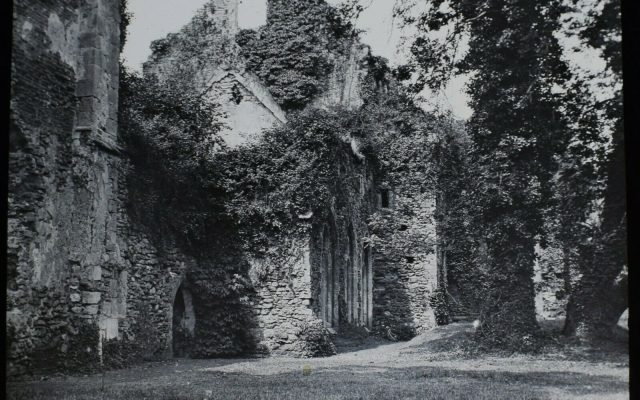
But the main complex survived. Abandoned, roofless, and slowly being consumed by ivy and vegetation, Netley Abbey began its transformation into something entirely new: a romantic ruin.
Paradise in Decay (1755-1840)
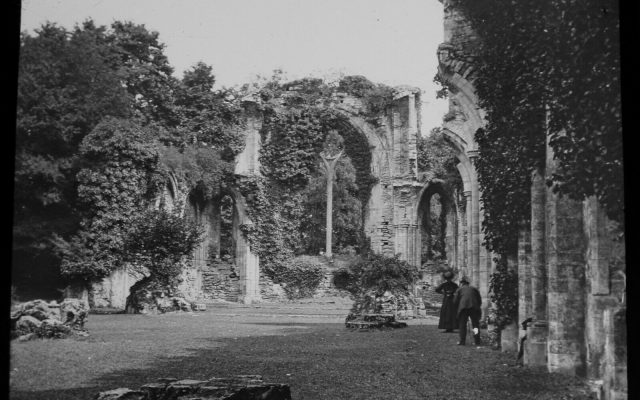
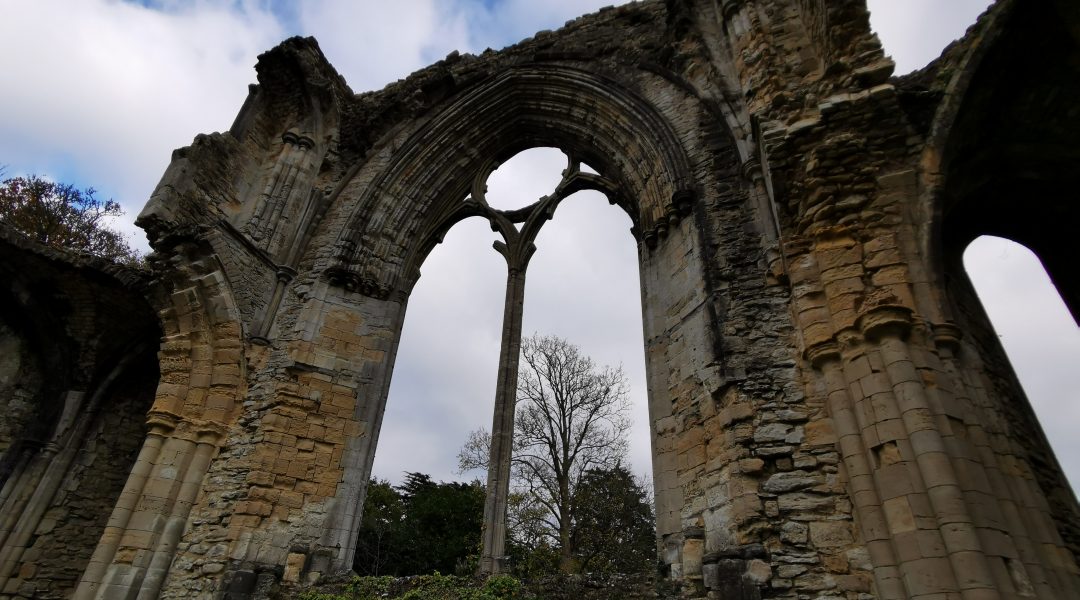
The eighteenth century discovered a new aesthetic: the picturesque. Ruins, once regarded as eyesores or sources of building materials, became objects of contemplation, melancholy, and beauty. Netley Abbey, with its soaring Gothic windows strangled by ivy and its nave open to the sky, was perfectly positioned for this cultural shift.
In 1755, Horace Walpole visited with the poet Thomas Gray. His letter afterwards captured the new sensibility:
The ruins are vast, and retain fragments of beautiful fretted roofs pendent in the air, with all variety of Gothic patterns of windows wrapped round and round with ivy… they are not the ruins of Netley, but of Paradise. Oh! the purple abbots, what a spot had they chosen to slumber in!
Walpole was not alone. Artists came to paint the ruins: John Constable in 1833, Francis Towne, and many others. Poets wrote verses. In 1794, William Shield’s operatic farce Netley Abbey was performed at Covent Garden. Richard Barham included the abbey in his Ingoldsby Legends, inventing a tale about a walled-up nun that he cheerfully admitted was fiction.
Jane Austen reportedly visited, and some scholars believe Netley influenced Northanger Abbey, her satire of Gothic fiction published in 1817. The connection is unprovable but plausible – Austen lived in nearby Southampton from 1806 to 1809, and the abbey was a popular excursion.
By the 1840s, Netley had become a tourist destination. Local people came for tea, dancing, and music among the ruins. Contemporary accounts complain that the romantic atmosphere was spoiled by “the popping of ginger beer.”
Preservation and Loss (1860-1922)
Victorian attitudes were more interventionist than Romantic ones. The owners of Netley – the Chamberlayne family, who had inherited the estate – decided to “improve” the ruins.
In 1860, archaeological excavations began under Charles Pink and Reverend Edmund Kell. They cleared debris, traced foundations, and documented what they found. But they also made a fateful decision: to remove the Tudor additions and return the abbey to its “pristine” medieval appearance.
The work stripped away much of the evidence of Netley’s post-Dissolution history. Paulet’s brick additions, the mansion’s interior arrangements, traces of the formal gardens – much was destroyed in the name of creating an idealised medieval ruin. The ivy and vegetation that Walpole had celebrated were cleared away.
What emerged was the Netley Abbey we see today: cleaner, more legible as medieval architecture, but stripped of four centuries of accumulated history.
In 1922, Tankerville Chamberlayne, the one-time Member of Parliament for Southampton, gifted the abbey to the nation. It became a Scheduled Ancient Monument in the care of the state, eventually passing to English Heritage.
The Unexcavated Abbey (1922-Present)
Modern archaeology has barely touched Netley Abbey. The 1860s excavations used Victorian methods – essentially digging until you hit something interesting – with no stratigraphic recording, no environmental sampling, no analysis of the kind that modern techniques allow.
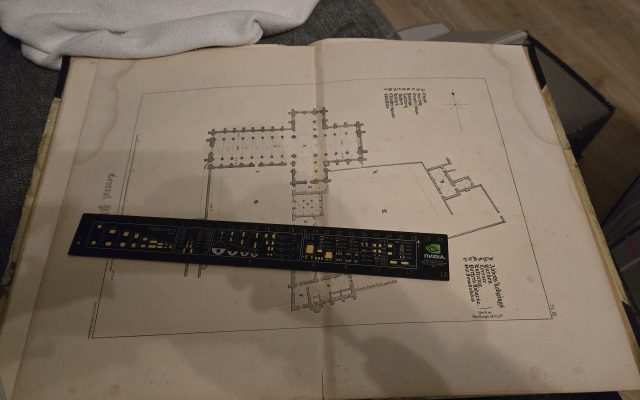
In 2005, the University of Southampton conducted geophysical surveys (resistivity, magnetometry, magnetic susceptibility) that revealed numerous unexcavated features: structures between the main buildings and the Abbot’s Lodging, anomalies within the church including a significant void beneath the crossing floor, and evidence of buildings in the precinct that have never been investigated.
The report was filed. Nothing happened.
Today, Netley Abbey remains one of the most complete Cistercian ruins in southern England – and one of the least understood. The precinct buildings have never been excavated. The fishponds are in private hands. The 2005 survey results sit largely ignored. English Heritage provides minimal interpretation: a few information panels, free entry, no visitor centre, no ongoing research.
The potential remains enormous. Environmental sampling from the drainage systems could reveal what the monks ate and what diseases they suffered. Excavation of the precinct could locate the guesthouses, workshops, and capella ante portas that served medieval travellers. Analysis of the tile and glass fragments could reconstruct the decorative schemes. Ground-penetrating radar has already hinted at what lies beneath the crossing – but no one has looked.
Netley Abbey has surrendered only a fraction of its secrets. The rest lies waiting, beneath the grass and the fallen stone, for someone to ask the right questions.
Visiting Netley Abbey
Netley Abbey is free to visit and open daily. The ruins are managed by English Heritage but have no visitor facilities on site.
Address: Abbey Hill, Netley, Southampton SO31 5GA
Getting there:
- By car: 4 miles southeast of Southampton via the A3025
- By train: Netley station (South Western Railway) is a 15-minute walk
- By foot: The Solent Way long-distance path passes nearby
What to see:
- The church, with three of Henry III’s inscriptions still visible on the crossing piers
- The chapter house, with its vaulted ceiling supported on four columns
- The vaulted undercroft of the Abbot’s Lodging
- The reredorter, with its intact drainage passage
- The south range, showing both medieval stonework and Tudor brick additions
Allow at least an hour to explore properly. The ruins are atmospheric at any time, but early morning and late afternoon light shows the stonework at its best.