From Tudor Fortress to Victorian Mansion: The Remarkable Transformation of a Hampshire Landmark
Perched on a wooded hillock overlooking Southampton Water, Netley Castle occupies one of the most enviable positions on the Hampshire coast. To the east lies the mouth of the River Hamble; to the west, the Itchen flows towards Southampton. Across the glittering waters, the Isle of Wight rises against the horizon. It is a view that has captivated visitors for nearly five centuries, from Tudor monarchs to Victorian aristocrats, from Romantic poets to the founder of the Scout movement himself.
Yet for all its beauty, Netley Castle began life not as a gentleman’s residence but as a squat artillery fort, bristling with cannon, built during one of the most ambitious military programmes in English history. Its story is one of reinvention: from coastal defence to picturesque ruin, from Gothic fantasy to nursing home, and finally to the exclusive private apartments it comprises today.
A King’s Device
In 1538, Europe’s two great Catholic powers, France and the Holy Roman Empire, signed the Treaty of Nice, ending decades of mutual hostility. For Henry VIII, who had broken with Rome just five years earlier to divorce Catherine of Aragon, this peace was ominous. The Pope had excommunicated him, and now France and Spain were free to turn their combined might against the heretic king. An invasion seemed not merely possible but likely.
Henry’s response was characteristically bold. In 1539, he issued a royal ‘device’—a documented plan—for a comprehensive chain of coastal fortifications stretching from Kent to Cornwall. It was the most extensive defence programme since Roman times, and it would cost the staggering sum of £376,000, equivalent to billions in modern currency. Much of this was paid for with wealth stripped from the dissolved monasteries, the very religious houses Henry had plundered to fund his break with Rome.
The Solent, gateway to both Southampton and the naval dockyards at Portsmouth, was deemed particularly vulnerable. William Paulet, later the 1st Marquess of Winchester and Lord High Treasurer of England, was charged with overseeing defences for the region. He recommended a triangulated system: Calshot Castle at the tip of its shingle spit would form the primary stronghold, supported by smaller artillery forts at St Andrew’s Point on the Hamble and at Netley.
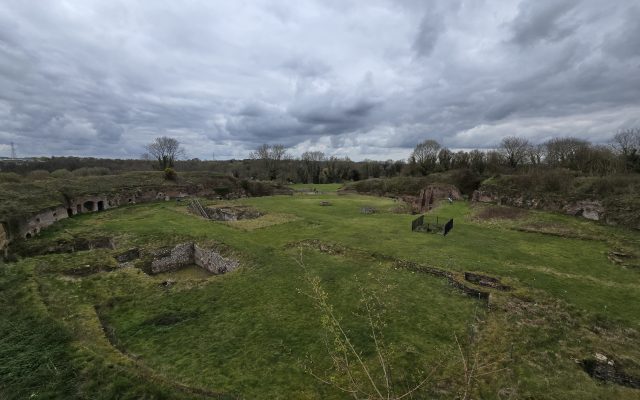
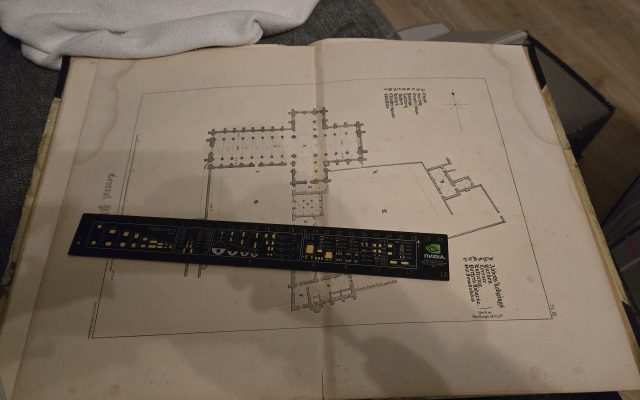
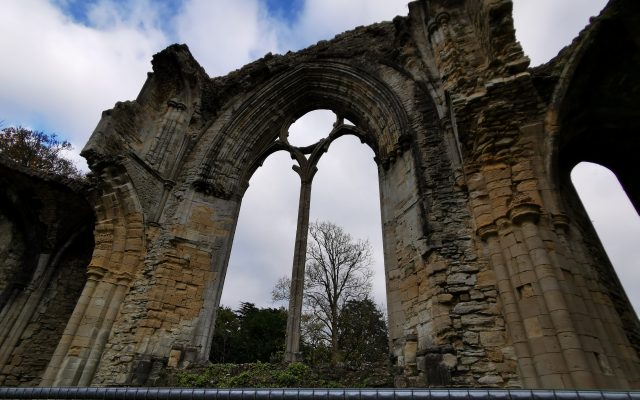
Construction at Netley began around 1542, and Paulet proved a pragmatic builder. Just 250 metres away stood the recently dissolved Netley Abbey, its Cistercian monks dispersed, its buildings already being converted into Paulet’s private mansion. The abbey’s medieval gatehouse, which had once faced the sea, was incorporated into the centre of the new fort. Cartloads of dressed stone were hauled from the abbey ruins to construct the castle’s walls—recycling on a grand scale that saved both time and money.
The resulting fortress was a utilitarian structure: a rectangular central keep measuring roughly 19.5 by 14 metres, with deep embrasures along the battlements and gun platforms flanking each side. Its design echoed that of nearby Southsea Castle. By March 1545, the garrison was operational, manned by a captain, two soldiers, six gunners, and a porter—a modest complement, but enough to make any French admiral think twice about landing troops on this stretch of coast.
Gunpowder and Garrison
The threatened invasion never materialised quite as Henry feared, though the French did mount a major assault in 1545. During the Battle of the Solent, French forces landed briefly on the Isle of Wight and fought a sharp action near Sandown, while English and French fleets clashed in the waters offshore—famously, this was the engagement that saw the Mary Rose sink within sight of Henry himself at Southsea. The Device Forts served their purpose: they raised the cost of invasion to a level the French were unwilling to pay.
Netley Castle remained garrisoned into the 1620s and was likely still active when the English Civil War erupted in 1642. Initially in Royalist hands, it was seized by Parliamentary naval forces under Captain Swaley by the end of that year. The Parliamentarians used its guns to threaten Southampton, blockading the water and preventing supplies from reaching the town. When Southampton fell to Royalist forces in 1643, the Parliamentarians stripped the castle of anything useful to prevent it being turned against them.
There was a brief return to service during the Interregnum, when fears of a Royalist counter-invasion prompted the Commonwealth to restore some coastal defences. But with the Restoration of Charles II in 1660, Netley Castle was deemed obsolete. The age of massive timber warships and increasingly powerful naval artillery had made such small fortifications strategically irrelevant. The castle was abandoned to the elements.
The Ruins of Paradise
By the early eighteenth century, Netley Castle had become what the Georgians called a ‘picturesque ruin’—overgrown, crumbling, but romantically beautiful. When the poet Alexander Pope visited in 1734, he found the site atmospheric and evocative, already being reclaimed by nature.
It was Horace Walpole, the writer, antiquarian, and father of the Gothic novel, who most memorably captured the spell of Netley. Writing to his friend Richard Bentley in September 1755 after staying nearby at The Vyne, Walpole was enchanted by both the abbey and its neighbouring fort. His description remains one of the finest pieces of Romantic topographical writing in English: the castle, he wrote, was ‘buried from the abbey in a wood, in the very centre, on the edge of the hill: on each side breaks in the view of the Southampton sea, deep blue, glistering with silver and vessels.’ He concluded rapturously that ‘they are not the ruins of Netley, but of Paradise.’
Walpole went further, suggesting that the fort might be made habitable by adding a tower. This idea would prove prescient. When William Chamberlayne inherited the castle in 1826, he took Walpole’s suggestion to heart. The following year, he constructed a crenellated tower at the south-east corner of the property—a Gothic fantasy grafted onto Tudor military architecture.
Visitors continued to arrive by boat, sailing down Southampton Water to admire both the castle and the neighbouring abbey. Artists came to sketch and paint; writers to find inspiration. The description from this period evokes a fairy-tale scene: the castle standing ‘in the midst of a thicket of trees, on a little hill close to the beach,’ forming ‘a striking object seen from the water.’ It is reported that Jane Austen herself visited Netley during her years in Southampton, between 1806 and 1809, and some scholars suggest the atmospheric ruins may have influenced her satirical take on the Gothic genre in Northanger Abbey.
A Victorian Gentleman’s Residence
The transformation of Netley Castle from romantic ruin to substantial private house began in earnest in 1841, when George Hunt leased the property from Thomas Chamberlayne. Under the supervision of architect George Guillaume, the castle was converted into a comfortable residence. Hunt remained until 1857, by which time the building boasted an oriel window overlooking the sea and the old battlements had been blocked in to allow the construction of a second storey.
George Sherriff took over the lease between 1868 and 1873, building the stone wall that still fronts the property. But it was Sir Henry Crichton, who purchased the castle outright in 1881, who truly transformed Netley into a gentleman’s seat. The surrounding gardens, orchards, pond, and boathouse all came with the purchase, and Crichton had ambitious plans.
For the remodelling, Crichton engaged one of the most distinguished architects of the age: John Dando Sedding. Sedding was a pivotal figure in the Arts and Crafts movement, a pupil of the great George Edmund Street (whose office had also trained William Morris and Philip Webb), and a man whose London studio at 447 Oxford Street stood next door to Morris & Co. His most celebrated work, Holy Trinity Sloane Street in Chelsea, was later described by John Betjeman as ‘the cathedral of the Arts and Crafts Movement.’
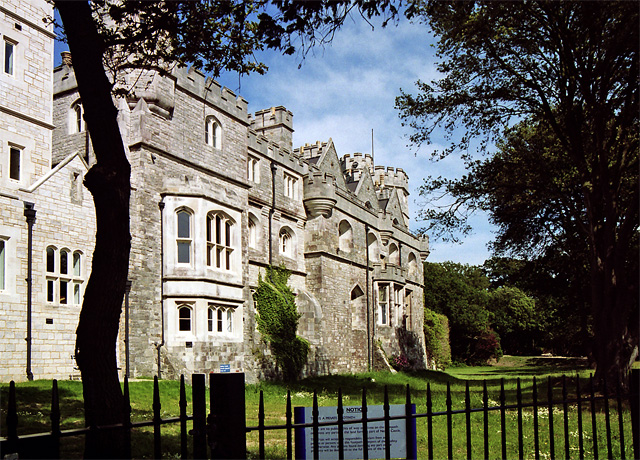
Between approximately 1885 and 1890, Sedding transformed Netley Castle into a Gothic Revival house of considerable style. He added a third storey, raised the tower, and constructed an entirely new wing on the south-east end. The result was an eclectic building that somehow harmonised five centuries of architectural history: the Tudor fort at its core, Georgian additions, and now Victorian Gothic elaboration, complete with octagonal towers and Arts and Crafts detailing.
The Crichton era brought notable guests. In 1912, Lord Baden-Powell and his new wife Olave honeymooned at Netley Castle as guests of the family—a romantic beginning for the couple who would together shape the global Scouting and Guiding movements. It is a charming footnote to the castle’s history that the founder of an organisation dedicated to outdoor skills and woodcraft should have spent his honeymoon in a Tudor fortress built to repel French invaders.
Sir Henry Crichton died in April 1922, but his second wife, Lady Emma, remained at the castle until her own death in January 1936. The following year, the property and grounds were sold at auction, ending nearly six decades of Crichton ownership.
Convalescence and Conversion
In 1939, Middlesex County Council purchased Netley Castle and converted it into a convalescent home for elderly men—a rather different garrison from the gunners of Henry VIII’s day. The building passed into NHS control in 1948 and continued operating as a nursing home for the next fifty years, though it proved expensive to maintain. The surrounding land was gradually sold off, and in 1998, the Southampton University Hospital NHS Trust finally closed the facility.
Fairmist Limited, a property development firm, purchased the castle in 2000 and undertook a £1.7 million conversion, creating nine private residential flats within the historic fabric. An archaeological survey conducted during the works helped document the building’s complex evolution. Today, Netley Castle stands approximately 62 metres long, 14 metres deep, and 13.5 metres tall, surrounded by 1.54 hectares of landscaped grounds. The original sixteenth-century fort remains incorporated into the centre of the property, though you would need an expert eye to distinguish it from the Victorian additions.
The castle is protected under UK law as both a Scheduled Monument and a Grade II* listed building—recognitions that acknowledge its exceptional architectural and historical significance. Apartments within its walls command prices approaching a million pounds, a testament to both the building’s unique character and the enduring appeal of that view across Southampton Water that so enchanted Horace Walpole nearly three centuries ago.
Legacy
Netley Castle’s story encapsulates much of English history in miniature. It was born from religious upheaval and international crisis, built with stones plundered from a dissolved monastery to defend against Catholic invasion. It served through civil war and Interregnum before falling into romantic decay, only to be reimagined by Victorians obsessed with the medieval past. In the twentieth century, it cared for the elderly and infirm before finding new life as desirable real estate in the twenty-first.
Unlike its more famous neighbours—the substantial ruins of Netley Abbey, now managed by English Heritage, or the vast Royal Victoria Country Park on the site of the demolished military hospital—Netley Castle remains in private hands, glimpsed from the shore path rather than visited. Yet its silhouette against the sky, part fortress, part fantasy, part home, speaks to something essential about how the English have always related to their past: not as museum curators but as improvisers, adapting, extending, and reinventing the buildings their ancestors left them.
Queen Elizabeth I is said to have stayed overnight at Netley Castle in 1560, visiting the Earl of Hertford at his converted abbey next door. Four and a half centuries later, the view she would have seen from the battlements—Southampton Water ‘deep blue, glistering with silver and vessels,’ the Isle of Wight rising beyond—remains essentially unchanged. In a landscape that has witnessed Roman occupation, Norman conquest, Tudor reformation, Victorian industry, and two world wars, that continuity is itself a kind of miracle. The ruins of Paradise endure.