There’s something quietly absurd about sitting on your sofa in Eastleigh on a Tuesday evening, ruler in hand, carefully measuring a picture in a book that’s older than your house. The book is a genuine 1848 first edition of George Guillaume’s Architectural Views and Details of Netley Abbey — yellowed, slightly foxed, smelling exactly like you’d expect a 177 year old book to smell — and it cost me £30 on eBay. Understanding Netley Abbey’s architecture has become something of an obsession, and this evening it has led me here: ruler, kitchen table, ancient book, and a growing suspicion that the master mason who designed this building was a genius of elegant simplicity.
But I’m getting ahead of myself.
The Problem With Measuring a Ruin
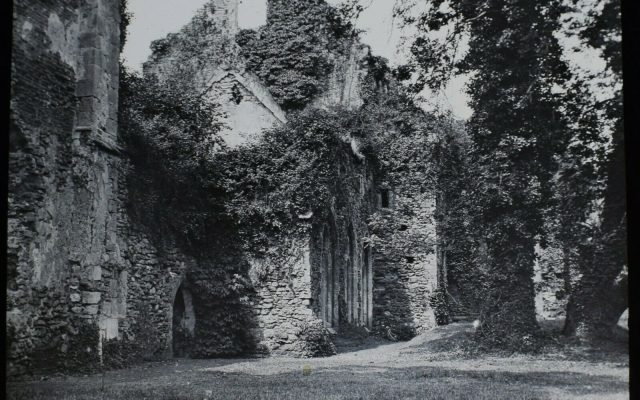
I’ve visited Netley Abbey more times than I can count. It’s one of those places that gets under your skin — the most complete Cistercian ruin in southern England, sitting quietly in its wooded parkland above Southampton Water, largely unexcavated and in many ways still deeply mysterious. I run this website. I’ve read everything written about it. And yet for a long time the basic question of how the building was actually designed — what geometric system the master mason used in 1251 — remained frustratingly unclear.
The published dimensions are inconsistent. Victorian surveys contradict each other. Google Maps measurements of a ruined medieval building produce numbers that are educational at best and misleading at worst. The British History Online entry for Netley, drawn from the 1908 Victoria County History, gives the church as 237ft by 136ft externally — useful, but external dimensions tell you relatively little about the geometric intentions of the original designer.
What I wanted was the internal geometry. The proportions the master mason actually worked from. The single measurement — if there was one — from which everything else derived.
It took two site visits and one extraordinary Victorian book to find it.
First Visit: November 2021
On 13th November 2021 I took my children Emma and Alex to Netley Abbey with a tape measure. It was a cold November afternoon and they were, shall we say, variably enthusiastic about the project. But we got some useful baseline numbers.
The large buttresses supporting the west wall measured 42 inches wide. The depth of the east wall buttresses came in at 76 inches. These aren’t glamorous measurements but they turned out to be significant — more on that shortly.
We also estimated the cloister as approximately 127ft × 127ft, though Guillaume’s survey — which I’ll come to — gives a more reliable figure of 114.6ft × 114.6ft. The discrepancy almost certainly reflects where exactly we were measuring from and to on a site where the cloister walks no longer exist above ground.
Second Visit: 16th March 2026
Yesterday I went back alone, this time with a proper 10 metre tape measure and a more systematic approach. The goal was to nail down the bay widths — the fundamental repeating unit of Netley Abbey’s architecture — from surviving stonework rather than from published sources.
The nave arcade pier bases survive as low stone stubs in the turf, enough to measure between them. Working along the nave I recorded the bay width — pier centre to pier centre — consistently at 14 feet. I measured this repeatedly across multiple bays. It didn’t vary significantly. Fourteen feet, bay after bay, running the full length of the nave.
In the south transept I noticed something I hadn’t seen on previous visits — a wooden pole, roughly the circumference of a broom handle, still in situ in the stonework of the pier between the transept body and the north chapel, approximately seven feet above the current ground level. The wood is still there after centuries, protected within the socket. Its most likely purpose was a curtain rail — screening the chapel entrance for private masses or seasonal liturgical hangings. It’s a small detail but the kind of thing that brings the building back to life.
I also measured the warming room at 227 inches wide, the chapter house arch at 121 inches, and several other spaces in the east range. The numbers were consistent and internally coherent — they were telling a story, though at that point I hadn’t fully worked out what the story was.
The Kitchen Table, the Ruler, and the 1848 Book
This is where Netley Abbey’s architecture starts to reveal its secrets.
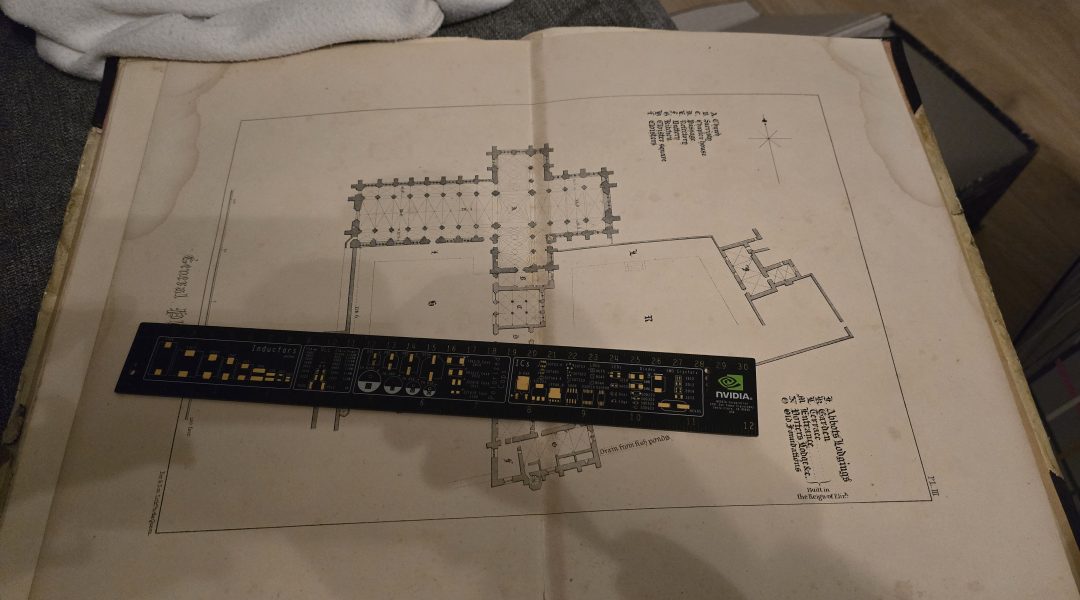
George Guillaume was an architect who surveyed Netley Abbey in the 1840s and published his findings in 1848 as Architectural Views and Details of Netley Abbey, partly shown as it originally existed: with brief historical associations of that ancient ruin and description of late discoveries. The book contains both detailed stated dimensions in the text and a full scale drawing of the church plan, complete with a scale bar at the bottom. My copy is a genuine first edition — you can feel the letters embossed into the paper from the original printing process, the lithograph plates have the slight texture of hand printing, and the whole thing has that particular smell of aged paper that no digital reproduction can replicate. I found it on eBay for £30, which still feels like a minor miracle.
You can view a digitised copy of Guillaume’s book at the Internet Archive, though the physical original is something else entirely.
Guillaume’s scale bar shows 63mm representing 100 feet. This means 1mm on the drawing equals 1.587 feet in reality.
Armed with a ruler, I started measuring.
The total internal length of the church — inner face of the west wall to inner face of the east wall — measured 132mm on Guillaume’s plan.
132 × 1.587 = 209.5 feet
Guillaume himself states the internal length as 211.3 feet in the text. The difference is 1.8 feet — a 0.8% error from measuring a printed illustration with a ruler. Close enough to confirm the scale bar is accurate and my ruler measurements are reliable.
Then I measured the individual sections:
- Nave alone: 73mm = 115.9 feet
- Crossing: 20mm = 31.7 feet
- Presbytery: 39mm = 61.9 feet
- Transept north to south: 75mm = 119.0 feet
73 + 20 + 39 = 132mm — the numbers add up exactly. Internal consistency confirmed.
What the Numbers Reveal About Netley Abbey’s Architecture
Here is where the geometry becomes remarkable.
The nave measures 115.9 feet for 8 bays — 14.49 feet per bay, consistent with my on-site measurement of 14 feet per bay to within normal measurement tolerance for worn medieval stonework measured with a 10 metre tape. Two completely independent methods — a tape measure on the ground in 2026 and a ruler on a Victorian drawing in 2026 — producing the same result.
The crossing measures 31.7 feet. The presbytery measures 61.9 feet for 4 bays — 15.47 feet per bay.
The crossing and presbytery bays are essentially the same size — approximately 15.5 to 16 feet each. The nave bays are smaller at approximately 14.25 feet each.
This difference is not an error. It is a historical record written in stone.
Netley Abbey’s history tells us the church was built in two campaigns. The east end — presbytery, crossing, and transepts — was built first, beginning around 1251 when Henry III became patron and began funding construction in stone. The nave came later, completed between approximately 1290 and 1320. Two different teams, potentially two slightly different master masons, working from the same overall design but with a subtly different bay unit.
The east end bays measure approximately 16 Roman feet each. The Roman foot — 0.296 metres, the pied de Cluny used by Cistercian builders across Europe — gives 16 × 0.296m = 4.736m = 15.54 feet. Essentially exactly what Guillaume’s plan shows.
The nave bays measure approximately 15 Roman feet each — 15 × 0.296m = 4.44m = 14.57 feet. Again consistent with my on-site measurement.
One Roman foot of difference between the two campaigns. Barely noticeable in the finished building. But mathematically distinct, and now readable in a 177 year old survey drawing measured with a ruler whilst sat on a sofa in Eastleigh.
The Single Measurement Behind the Entire Building
Guillaume also gives the nave width as 57 feet internally — confirmed by my own cloister measurements and by the stated dimensions in his text. The nave is divided into three equal parts: the nave body plus two aisles, each approximately 19 Roman feet wide.
Call this base unit M = 19 Roman feet ≈ 19 feet in modern measurement.
From M, the entire Netley Abbey architecture derives:
| Element | Formula | Feet | Source |
|---|---|---|---|
| Nave width | 3M | 57ft | Guillaume stated ✓ |
| Cloister garth | 6M | 114ft | Guillaume stated 114.6ft ✓ |
| Nave length | 6M | 114ft | Guillaume plan ✓ |
| Nave bay | ¾M | 14.25ft | On-site 14ft ✓ |
| East buttress depth | M/3 | 76 inches | On-site 76 inches ✓ |
The entire church — nave, crossing, presbytery, transepts, cloister — derives from a single measurement. The master mason arrived on site in 1251 with one rod of a fixed length. Every pier position, every wall line, every bay division was set out by repeating that rod or a simple fraction of it. No arithmetic. No calculation. Just a rope, stakes, and the geometric discipline to repeat one measurement consistently across a 200 foot building.
This also explains why Netley Abbey resembles Westminster Abbey so closely. Henry III’s masons were working simultaneously on both buildings from 1251, using the same Roman foot rod system. Netley is Westminster at a more modest scale — same geometric grammar, same unit of measure, same master mason tradition.
The Vesica Piscis: The Hidden Geometry of Netley Abbey
Guillaume knew there was something deeper going on. His book includes a diagram showing the Netley Abbey church plan laid out on a Vesica Piscis construction — the ancient geometric figure formed by two overlapping circles of equal radius, producing the characteristic eye or almond shape between them.
The eye shapes of the vesica appear across the entire plan, all perfectly aligned with the pier positions. The nave body width of 33 feet is M × √3 — the height of an equilateral triangle constructed on M. The total nave width of 57 feet is M × 3. The relationship between the nave body and total width — 33:57 — is the ratio 1:√3, the fundamental proportion of the Vesica Piscis.
The master mason didn’t calculate √3. He drew two circles with a compass set to one radius, and the proportion emerged automatically from the geometry. The pointed arches, the vault profiles, the window tracery — all of it generated by the same compass operation at different scales. The Cistercian architectural tradition brought this system from France, where it had been refined over a century of abbey building before Netley was even founded.
One measurement. One compass. Eight hundred years later, still readable in the stonework.
What Happened to the Building Afterwards
Understanding the geometry makes what William Paulet did to Netley after the Dissolution even more striking. In 1536 he received a building whose every dimension was a precise multiple or fraction of one rod length — a masterpiece of geometric discipline — and converted it into a Tudor mansion by knocking doors through walls, inserting mezzanine floors, and demolishing the north transept entirely.
The geometry survived because the walls survived. Paulet could rearrange the spaces but he couldn’t change the proportions. The rod is still there in the stonework, waiting to be read by anyone who turns up with a tape measure and enough patience.
The tunnel beneath the east range — which carried the drainage system — is itself a product of the same geometric precision. The monks who designed the drainage were working from the same module as the masons who built the church above it.
A Note on Method and Accuracy
I want to be clear about what this analysis is and what it isn’t.
The on-site measurements were taken with a 10 metre tape measure on two visits — 13th November 2021 and 16th March 2026. They are careful but not precision survey measurements. The Guillaume measurements were taken with a ruler from a printed book illustration — accurate to approximately 0.5mm, translating to approximately 0.8 feet at building scale.
The conclusions about Roman feet, building campaigns, and the Vesica Piscis are well-reasoned interpretations of those measurements, not established archaeological fact. They are consistent with the known history of Netley Abbey, with Cistercian building practice of the period, and with the geometry visible in Guillaume’s own drawings. But they have not been verified by professional archaeological survey.
What I can state with confidence is that the measurements are internally consistent across two independent sources — my own on-site tape measurements and Guillaume’s 1848 architectural survey — to a degree that would be unlikely to occur by chance. My on-site bay width of 14 feet and Guillaume’s plan measurement of 14.49 feet per bay agree to within 3.5%. My cloister estimate and Guillaume’s stated 114.6ft point to the same 6M dimension. The geometry holds.
The single rod is real. The rest is interpretation — offered honestly as such, in the hope that someone with a ground-penetrating radar and an excavation licence will eventually come along and tell us whether we’re right.
I’m a software developer based in Eastleigh. I’ve been visiting and researching Netley Abbey for many years and run this site as an independent historical research project. I have no formal archaeological qualifications and no affiliation with English Heritage. I’m just someone who keeps turning up with a tape measure and won’t stop asking questions.