The Cistercian order brought a distinctive architectural language to medieval England. Their monasteries followed a standardised layout refined over centuries, with each building serving a specific purpose in the monks’ daily routine of prayer, work and contemplation. Understanding these terms brings the ruins to life and reveals the logic behind what can otherwise seem like a confusing jumble of walls.
Netley Abbey, founded in 1239, follows the classic Cistercian plan. Almost every term below can be seen in its ruins today.
A
Abbot’s Lodging
From Latin abbas (father). The private residence of the abbot, the head of the monastery. By the later medieval period, abbots often lived in considerable comfort separate from the monks they led. At Netley, the Abbot’s Lodging stands apart from the main complex to the east, with its own vaulted undercroft still intact. After the Dissolution, it was incorporated into the Tudor mansion.
Ambulatory
From Latin ambulare (to walk). A processional walkway, typically running around the eastern end of a church behind the high altar. Larger abbey churches used ambulatories to allow pilgrims to circulate past shrines without disturbing services. Netley’s church is relatively modest and lacks a true ambulatory.
Ashlar
From Old French aisselier (board, plank). Dressed stone blocks with flat faces and square edges, laid in regular courses. More expensive than rubble construction, ashlar was typically reserved for prestigious areas. At Netley, the church features ashlar facing, though much has weathered over the centuries.
C
Capella ante Portas
Latin for “chapel before the gates”. A small chapel located outside the monastery’s main entrance, provided for the use of lay visitors and local people who were not permitted inside the monastic church. Cistercian churches were reserved exclusively for the monks, so this external chapel served the spiritual needs of everyone else. Netley’s capella ante portas has not survived, but would have stood near the outer gatehouse.
Cellarium
From Latin cella (storeroom). The great vaulted undercroft beneath the lay brothers’ range, used for storing food, drink and supplies. Often the most impressive surviving space in ruined abbeys due to its robust vaulted construction. At Netley, the cellarium forms part of the west range and retains its medieval vaulting.
Chapter House
From the practice of reading a chapter of the Rule of St Benedict daily. The meeting room where monks gathered each morning to hear readings, confess faults, receive instructions and conduct monastery business. Typically an impressive architectural space reflecting its importance. Netley’s chapter house is a magnificent three-aisled chamber with vaults supported on four columns, with a stone bench running around the walls and the abbot’s throne at the centre of the east wall.
Choir
From Latin chorus via Greek khoros. The area of the church where the monks sat in wooden stalls to sing the daily offices. In a Cistercian church, the choir typically occupied the crossing and the eastern bays of the nave, separated from the rest of the church by screens. The monks spent many hours here each day, gathering eight times in every twenty-four hours for prayer.
Cloister
From Latin claustrum (enclosed place). The covered walkway surrounding a rectangular open courtyard (the garth), forming the heart of the monastery. The cloister connected all the major buildings and served as a workspace – monks read, wrote and studied in the cloister walks. The north walk, against the church, was typically used for reading and writing due to its light. At Netley, the cloister survives as foundations, its walks demolished when William Paulet converted the abbey to a mansion.
Crossing
The space where the nave and transepts intersect, usually beneath a tower. This was the architectural and liturgical heart of the church. At Netley, three of the four massive crossing piers survive, still bearing King Henry III’s inscription: “H DI GRA REX ANGL” (Henry, by the Grace of God, King of England).
Culvert
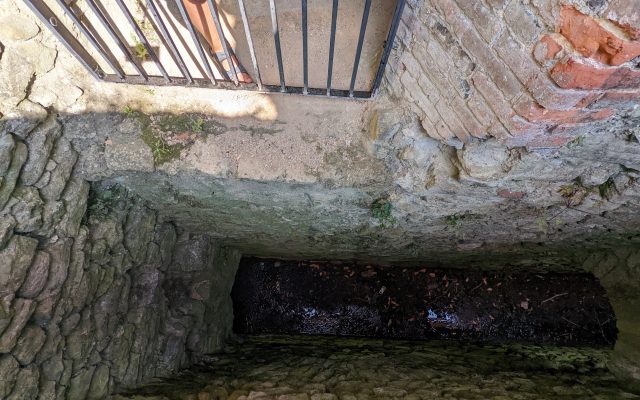
From Old French couvert (covered). An underground channel for water or drainage. Monasteries required sophisticated water management for sanitation, cooking and industrial processes. At Netley, an underground stream runs through a vaulted passage beneath the reredorter, flushing the latrines – a system still partially functional after 800 years.
D
Dorter (Dormitory)
From Latin dormitorium (sleeping place). The communal sleeping quarters for the monks, typically located on the upper floor of the east range for convenient access to the church for night offices. Monks slept clothed on straw mattresses in a single large room, though by the 14th century many monasteries subdivided their dorters into private cells. At Netley, the dorter was converted into a long gallery during the Tudor mansion phase.
Day Stairs
The staircase connecting the dorter to the cloister, used during daylight hours. Distinguished from the night stairs which led directly into the church. At Netley, the day stairs would have been at the southern end of the east range.
E
East Range
The range of buildings along the eastern side of the cloister, typically containing the sacristy, chapter house, parlour, and dorter above. This was the monks’ domain, as opposed to the west range which housed the lay brothers.
Encaustic Tiles
From Greek enkaustikos (burned in). Decorated floor tiles where the pattern is created by inlaying different coloured clays before firing. Netley’s floors were covered with polychrome encaustic tiles featuring foliage, heraldic beasts, and coats of arms including those of England, France, the Holy Roman Empire, and Queen Eleanor of Castile.
F
Frater (Refectory)
From Latin refectorium (a place of restoration). The monks’ dining hall. Cistercian fraters were typically aligned north-south, projecting from the cloister’s south range. Meals were eaten in silence while a monk read aloud from a pulpit. At Netley, the medieval frater was demolished by William Paulet to create the entrance frontage for his Tudor mansion – only foundations survive.
G
Garth
From Old Norse garðr (enclosure). The open courtyard at the centre of the cloister, usually laid to grass or planted as a garden. The garth was a contemplative space at the heart of the monastery. At Netley, William Paulet converted it into a formal courtyard with a central fountain.
Gatehouse
The controlled entrance to the monastery precinct. Larger monasteries had both an outer gatehouse at the precinct boundary and an inner gatehouse closer to the cloister. At Netley, the original gatehouse stood close to the shoreline – Henry VIII later converted it into a coastal fort, which evolved into the building now known as Netley Castle.
I
Infirmary
From Latin infirmus (weak, sick). A separate complex for sick, elderly and convalescing monks, with its own chapel, kitchen and sometimes a private garden. The infirmary followed a relaxed rule, allowing meat and more comfortable conditions. At Netley, excavations have not confirmed whether there was a separate infirmary complex, though a vaulted hall with a 13th-century fireplace at the south end of the east range may have served this function.
L
Lavatorium
From Latin lavare (to wash). A trough or basin where monks washed their hands before meals, typically located in the cloister near the frater entrance. Often architecturally elaborate, with running water supplied by lead pipes.
Lay Brothers
Conversi in Latin. Illiterate men who took religious vows but focused on manual labour rather than the full liturgical round. They lived separately from the choir monks, occupying the west range, and had their own entrance to the church. The lay brother system allowed Cistercian monasteries to run large agricultural operations. By the 14th century, labour shortages caused by the Black Death led most monasteries to abandon the system and hire paid workers instead.
N
Nave
From Latin navis (ship) – possibly from the resemblance of a vaulted ceiling to an inverted hull. The main body of the church, west of the crossing. In Cistercian churches, the nave was divided: the eastern end contained choir stalls for lay brothers, while the western end was generally empty, separated by a screen. At Netley, William Paulet converted the nave into his great hall and kitchens.
Night Stairs
A staircase leading directly from the dorter into the church transept, allowing monks to descend for night offices (Matins, Lauds) without going outside. Speed and convenience mattered when you were rising at 2am. At Netley, the night stairs were in the south transept, and their position is still visible in the wall.
P
Parlour
From Old French parler (to speak). One of the few places in a Cistercian monastery where conversation was permitted. Usually a small room off the cloister’s east walk, used for necessary communication. The monks observed strict silence elsewhere.
Piscina
From Latin piscis (fish) – originally meaning a fish pond, later a basin. A stone basin with a drain, set into the wall near an altar, used for washing communion vessels. The water drained directly into the ground rather than into the common drainage system, as it was considered sacred.
Precinct
From Latin praecingere (to encircle). The entire enclosed area of the monastery, bounded by walls or banks and ditches. The precinct contained not just the church and cloister but also farms, workshops, fishponds, orchting, stables, guest accommodation and gardens. At Netley, the precinct bank and ditch are still visible, and the 2005 Southampton University geophysical survey revealed previously unknown structures within it.
Presbytery
From Greek presbyteros (elder). The eastern arm of the church containing the high altar, reserved for the priests celebrating Mass. At Netley, the presbytery was retained as the chapel of the Tudor mansion after the Dissolution.
Pulpitum
Latin for platform or stage. A stone screen separating the monks’ choir from the nave, typically with a central doorway and sometimes an upper gallery. More substantial than a rood screen. At Netley, the pulpitum would have stood at the west end of the crossing.
R
Reredorter
From Old French rere (behind) and dorter (dormitory). The communal latrine block, typically positioned at the far end of the dorter with running water beneath to flush waste away. The reredorter at Netley is one of the best preserved parts of the abbey, with its vaulted undercroft still intact. An underground stream runs through a vaulted passage beneath, carrying waste to Southampton Water. This passage has likely contributed to legends of “secret tunnels” at the abbey.
Rood Screen
From Old English rōd (cross). A screen separating the nave from the chancel, topped by a large crucifix (the rood) flanked by figures of Mary and John. In parish churches the rood screen divided clergy from laity; in monastic churches it served to separate different parts of the community.
S
Sacristy
From Latin sacer (sacred). A secure room adjoining the church where vestments, vessels and valuables were stored. Often combined with a library in smaller monasteries. At Netley, the sacristy was positioned between the south transept and the chapter house.
Scriptorium
From Latin scribere (to write). The room where manuscripts were copied and illuminated. In practice, much writing was done in the cloister walks where the light was better. Only one book definitively from Netley’s scriptorium survives: British Library Arundel MS 69, a 13th-century copy of Roger of Hoveden’s Chronicles.
Slype
Origin uncertain, possibly from Old English slīpan (to slip). A covered passage, typically running between the chapter house and the south transept, providing access from the cloister to the area east of the main buildings – often the cemetery or infirmary.
South Range
The range of buildings along the southern side of the cloister, typically containing the frater, kitchens and warming house. At Netley this range was heavily rebuilt during the Tudor conversion.
T
Tracery
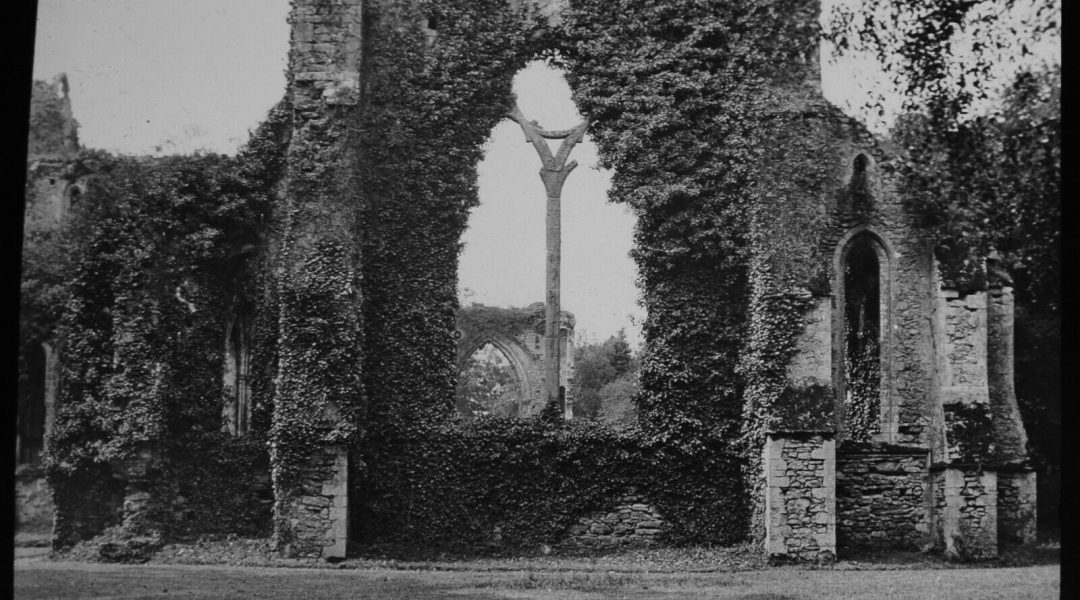
From Old French tracier (to trace, draw). The ornamental stonework holding the glass in Gothic windows, creating patterns of mullions and carved openings. Netley’s east window and the windows of the south transept retain beautiful examples of 13th-century Gothic tracery, though the glass is long gone.
Transept
From Latin trans (across) and septum (enclosure). The arms projecting north and south from the crossing, giving the church its cruciform plan. Transepts typically contained additional altars in chapels along their eastern walls. At Netley, the south transept survives well; the north transept was dismantled by Thomas Dummer in the 1760s and re-erected as a folly at Cranbury Park, where it still stands.
Treasury
From Old French tresor. A secure room for storing valuables, plate and important documents. At Netley, a tiny vaulted treasury room survives at the north end of the dorter, positioned there so the sleeping monks would hear any intruder.
U
Undercroft
From under + croft (enclosed space). A vaulted basement or ground floor supporting the main rooms above. Undercrofts provided storage, workspace, and structural support. At Netley, the undercrofts of the Abbot’s Lodging, reredorter and west range survive with their vaulting intact.
W
Warming House (Calefactory)
From Latin calefacere (to make warm). The only room in the monastery (besides the kitchen and infirmary) where a fire was permitted. Monks could warm themselves here during the coldest months. At Netley, the warming house was in the south range, adjacent to the frater.
West Range
The range of buildings along the western side of the cloister. In Cistercian monasteries this was the lay brothers’ domain, containing their dorter above and the cellarium below, with their own frater at the southern end. As lay brother numbers declined, west ranges were often converted to other uses.
Further Reading
- Hare, J. (1994) ‘Netley Abbey: monastery, mansion and ruin’, Proceedings of the Hampshire Field Club Archaeological Society, 49, pp. 207-277
- Coppack, G. (1998) The White Monks: The Cistercians in Britain 1128-1540
- Robinson, D.M. (2006) The Cistercians in Wales: Architecture and Archaeology 1130-1540